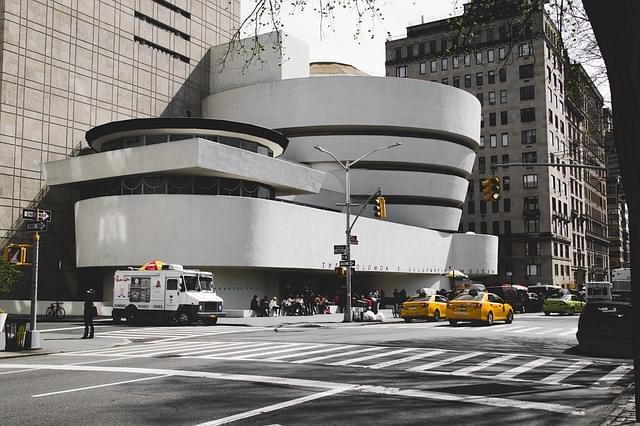
 The Guggenheim is considered one of the most famous museums in New York and the world thanks to its collection of modern and contemporary art. Not only that, the structure that houses this art gallery is itself a work of art: the building has a cylindrical shape with the lower base smaller than the upper one and externally it is surrounded by a white ribbon.
The Guggenheim Museum is located in the heart of New York and precisely a few steps away from the luxurious storefronts of Fifth Avenue and one of the entrances to Central Park. Therefore, even if you don't plan to visit art galleries and galleries during your American stay, you can't fail to come and see this architectural gem from the outside.
SEE ALSO: What to see in New York
What to see and how to visit Guggenheim Museum
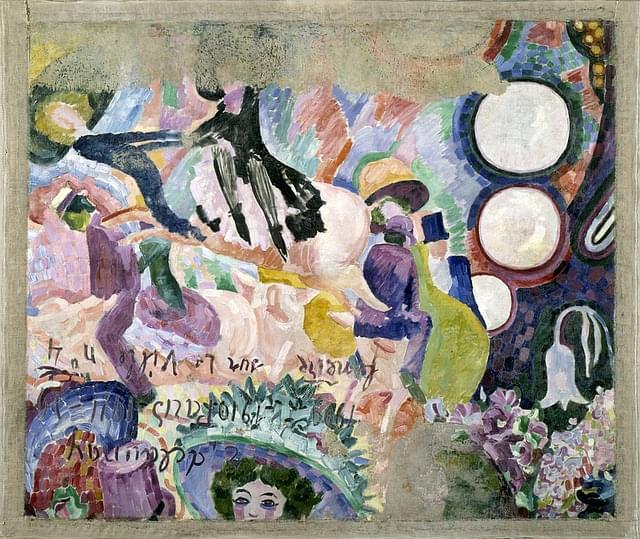 The4,000 square metre structure consists of six exhibition floors and a transparent dome that surmounts the spiral and serves to give light to the interior. In the 1990s an eight-storey tower was added to the east in order to enlarge the structure. The museum has 7,000 works, but they are never exhibited all at once but in rotation, and in addition to the permanent collection there are always temporary exhibitions. Among the best known artists in the catalogue are: Paul Cezanne, Paul Gaugain, Eduard Manet, Pablo Picasso, Kandinsky, Chagall and many others.
To visit the Guggenheim once you enter the atrium you have to take the lift to the top floor and then go down the spiral staircase just as architect Frank Lloyd Wright suggested. However, due to the crowding in the small lift, you are often forced to watch the exhibition from the ground floor. Here are 10 works not to be missed!
1 - Yellow cow
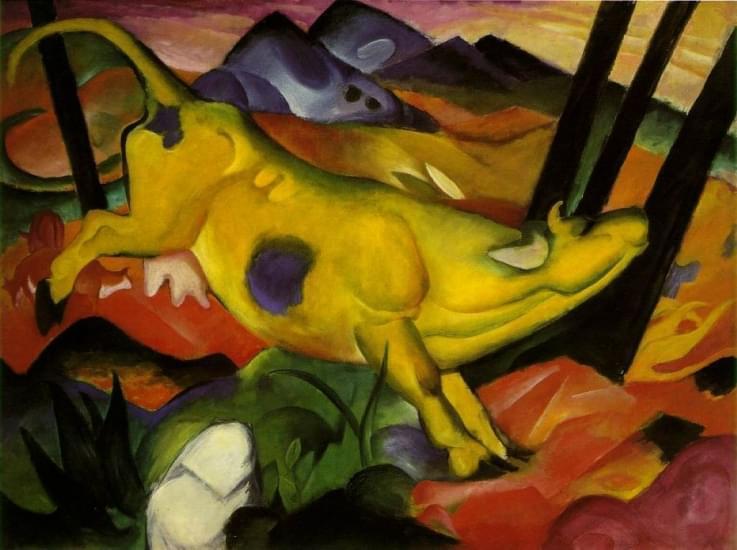 The painting's protagonist is a slender and graceful yellow cow chosen by the author to emphasise that gracefulness is present in everyone.
Date of creation: 1911
Author: Franz Marc Chagall
Dimensions: 1.4 m x 1.89 m
Technique and subject of work: bovine subject painted in oil on canvas
2 - The Green Violinist
The protagonist of the work is a violinist dressed in purple, with a green face and a dog. The author chose this instrument because in his opinion it represents the means to encounter God and the secrets of life and death.
Date of creation: 1923
Author: Marc Chagall
Dimensions: 78 cm x 42 cm
Technique and subject of work: oil painting on canvas
3 - Jeanne Hébuterne in Yellow Sweater
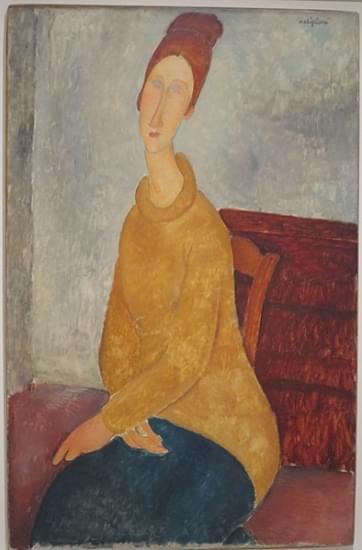 The painting depicts Jeanne Hebuterne, a young woman with whom Modigliani had a strong emotional bond and who committed suicide two days after the painter's death.
Date of creation: circa 1919
Author: Amedeo Modigliani
Size: 100×65 cm
Technique and subject of work: human subject painted in oil on canvas
4 - Study for Composition II
This painting marks the transition from the painter's figurative to his abstract phase. It was created as a study for another painting that was destroyed during the Second World War. Although the artist did not want to paint a specific theme, some people see biblical or pagan subjects in it.
Date of creation: 1910
Author: Vasily Kandinsky
Dimensions: 97.5cm x 130.5cm
Technique and subject of work: abstract work painted on canvas
5 - Sweet Ascent
This picture was painted by the author shortly after his arrival in Paris and the painter wanted to paint many fantastic beings (the colours blurred and evanescent) emerging from the abysses of the unconscious
Date of creation: 1934
Author: Vasily Kandinsky
Dimensions: 80.4cm x 80.7cm
Technique and subject of work: Abstract subject painted in oil on canvas
6 - The Peasant Woman Sitting in a Meadow
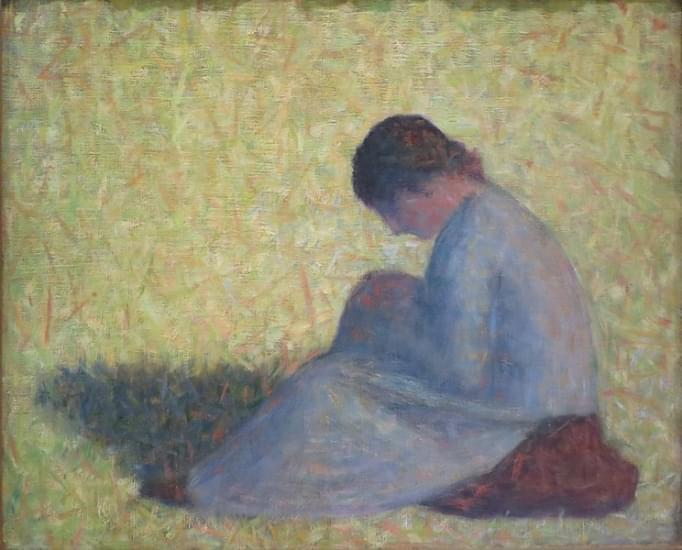 This painting by the French painter, one of the greatest exponents of the Post-Impressionist movement and the technique of pointillism, depicts a seated woman. One can note the strong contrast with the background, the lack of detail and the immobility of the subject.
Date of creation: 1883
Author: Georges-Pierre Seuret
Size: 38.1cm x 46.2cm
Technique and subject of the work: oil portrait on canvas
7 - Reclining Nude
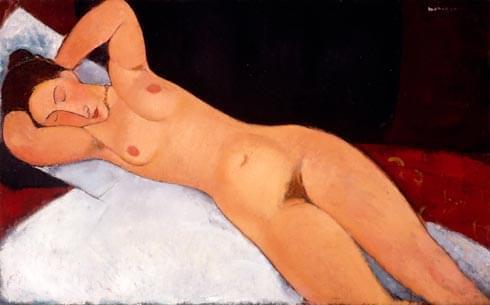 This work is distinguished by the sensuality conveyed visually by the position of the woman. Modigliani has portrayed a woman lying on a cushion with her arms folded behind her head, highlighting her intimate organ covered in hair.
Date of creation: between 1917 and 1918
Author: Amedeo Modigliani
Size: 60x90 cm
Technique and subject of work: oil painting on canvas
8 - Mountains in Saint Rémy
The work was painted by the author during his hospitalisation at Saint Paul de Mausole in the South of France.
The painting depicts the Alps that he could see through the small windows of his room, which he decided to turn into a small painting studio during his stay.
Date of creation: 1889
Author: Vincent Van Gogh
Dimensions: 71.8 x 90.8 cm
Technique and subject of work: landscape painting in oil on canvas
9 - Ocean Greyness
Pollock's abstract work depicts several disembodied eyes hidden amongst the coloured fragments materialised by the grey ground. What emerges in this painting is the dynamic tension between representation and abstraction.
Date Created:1953
Author: Jackson Pollock
Dimension:
Technique and subject of work: oil painting on canvas
10 - Red Balloon
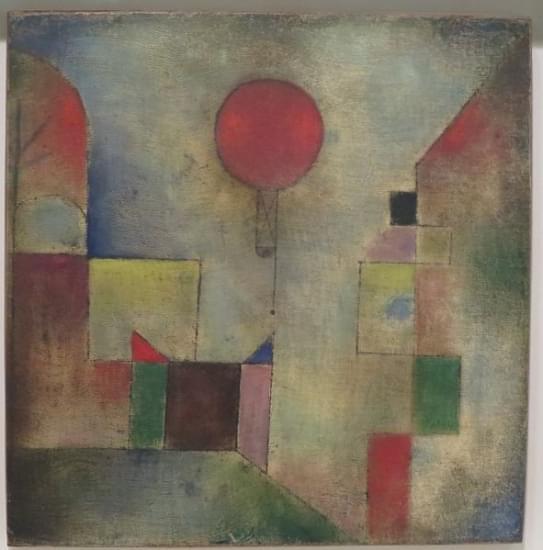 This work depicts a red balloon floating on a cluster of geometric shapes. The cubist technique used by the painter serves to make the main object stand out quickly in order to immediately capture the viewers' attention.
Date Created:1922
Author: Paul Klee
Size: 32x31 cm
Technique and subject of work: oil on canvas muslin.
Hours and Prices
The Guggenheim Museum is open every day of the year except Thursdays, 25 December and Thanksgiving.
Hours: Mon-Mon-Wed-Fri-Sun 10am-5:45pm; Sat 10am-7:45pm.
Besttime to avoid queues: the best time to avoid queues and to enjoy the works in the gallery at a leisurely pace is 10:00 am, as soon as the museum opens.
On Saturdays the Guggenheim is often overcrowded, especially from 5.45pm when admission is free. Monday afternoons are also not a good day to visit as other museums in New York are closed and those in the mood for art and culture come here.Ticket Price: Admission to the Guggenheim Museum is $25 (€22.00 approx.) for adults, $18 (€16.50) for students and people over 65. Purchase online
Free of charge: under 13 years of age. On Saturdays from 5.45pm admission is free, or as the Americans say 'Pay What You Wish'.
Miscellaneous: This Museum, like many other New York attractions, is included in the New York Pass, City Pass and Explore Pass.
Online Tickets and Guided Tours
Useful tips for visiting the attraction
When it comes to visiting museums, one thing must be said: every person has different interests, so some people like to spend the whole day inside an art gallery and others only need a couple of hours. Having said that, we would like to give you a few pointers to help you during your visit to the Guggenheim Museum.
Getup early: Ideally, you should get to the entrance around 9.30am, so that you are already in the queue when the ticket offices open.
Buya city card: If you are interested in visiting other museums or attractions in the city, you can buy one of the many city cards and save money on admission. Find out more about the New York Pass- Learn more about the New York Explorer Pass.
Priority Ticket: Purchase a Priority Access Ticket to avoid the endless lines you may encounter on weekends and holidays. Learn more about the Priority Access Ticket.
Minimumtime: we recommend that you allow a minimum of 2-3 hours for your visit, although
although ideally you should be able to dedicate 4 hours of your time.Guides, apps and audioguides: At the entrance you can take audioguides in different languages that will introduce you to the world of art by explaining all the works in the museum. Alternatively, you can download the useful Guggenheim App available for both Apple and Android. Finally, the guided tours that start daily at 11:00 am and 1:00 pm and take visitors through the most valuable works from both the permanent and temporary collections are very interesting.
Where it is located and how to get there
The Guggenheim Museum in New York is located at 1071 Fifth Ave, at 89th St., New York.
It can be reached in several ways depending on where you are.
Byfoot: If you're in the Upper Esast Side area, you can get to the Guggenheim with the help of a map Get directions
By underground: the alternative is the convenient 4,5 and 6 underground lines that stop at 86th Street just a short walk from the art gallery.
History and interesting facts: What to know in brief
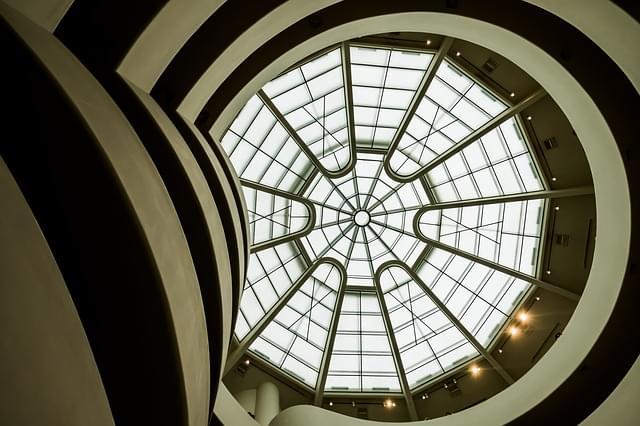 The Guggenheim Museum building was designed byarchitect Frank Lloyd Wright initially to house the private collection of Solomon R. Guggenheim, a New York mining magnate, then as a picture gallery for many other works. It was completed in 1959 and neither Wright nor Guggenheim saw the outcome. Since its inauguration, however, this structure has often appeared in films, TV programmes and billboards.
Related articles
Where to sleep in New York: tips and best places to stay
Where to go to the beach in New York | Beaches near New York
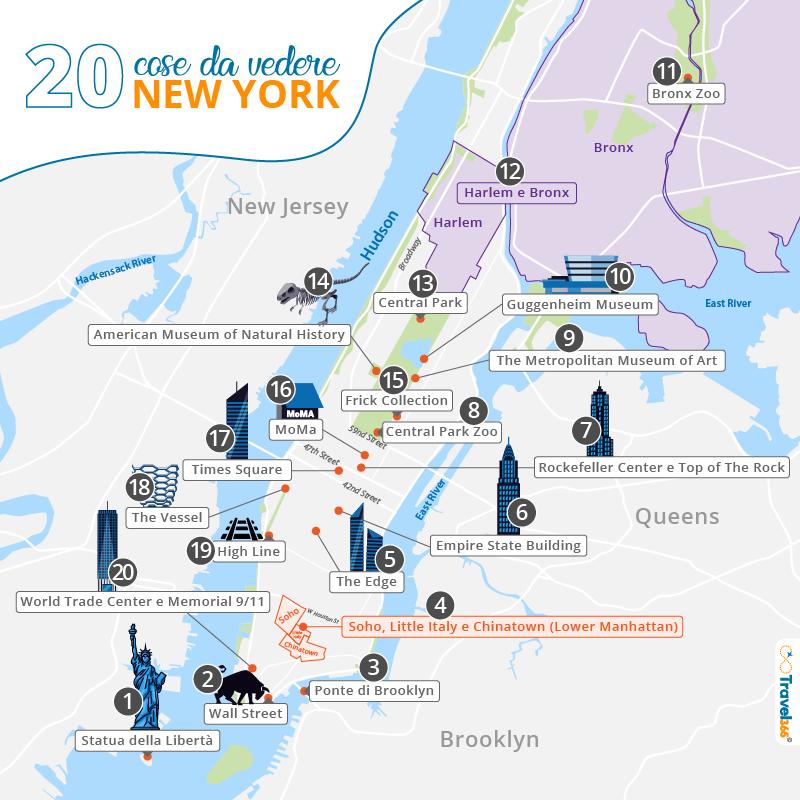
What to see in New York: 20 best attractions and things to do

New York itinerary in 7 days
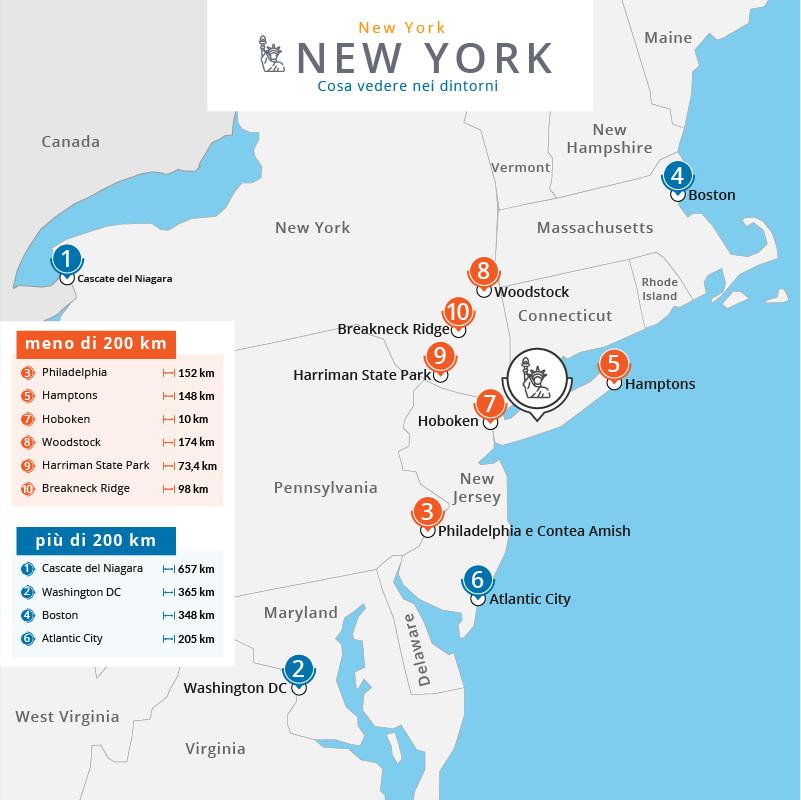
Excursions from New York: the best day trips around New York City

Christmas 2024 in New York: what to do, practical info and tips

Nightlife in New York City: clubs and nightlife districts
Visiting New York's Central Park: How to get there, prices and tips