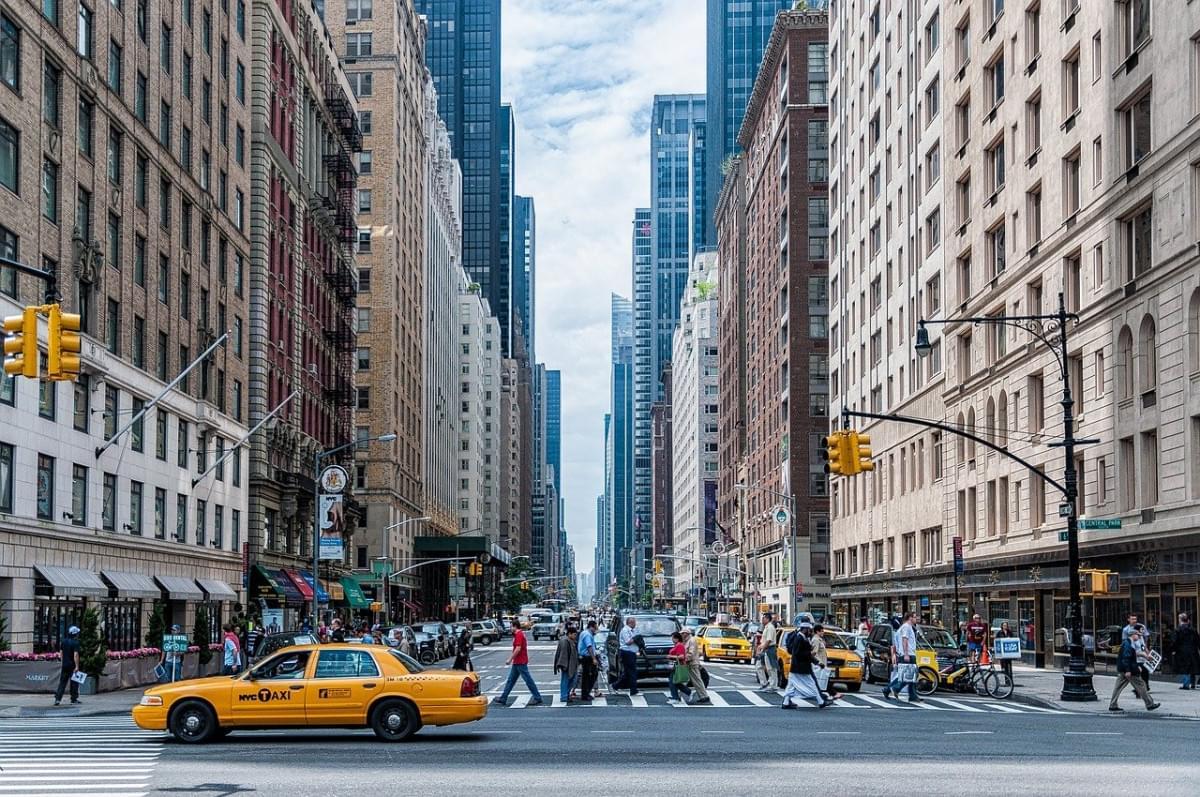
 New York can seem chaotic and dispersed at first glance: taxis, riders, buses, subways. Mobility is definitely a matter to be taken with caution, or you risk getting stuck in traffic or lost between underground stations, as the New York underground is one of the most extensive in the world!
But don't worry, once you understand how it works, it will be really easy to discover the length and breadth of the Big Apple.
Arrive in the city prepared: here's how to get around New York!
WATCH THE INFOGRAPHIC: Getting around New York
Useful tips
New York is a very large city, so visiting it all on foot is almost impossible, especially if you are short on time. This is instead an effective solution when visiting individual areas, such as neighbourhoods.
Thebest way is definitely the underground: fast, punctual and reaches every borough, from Manhattan you can even get to Brooklyn, Queens or the Bronx. Buses and cars are not recommended, mainly because of the traffic. Thetourist bus, on the other hand, follows fixed routes with stops near the main attractions. Alternatively, get around by taxi or Uber, but be careful, only get on the official ones!
For public transport, it is highly recommended to buy the MetroCard, a rechargeable card costing $1.00 (€0.90) that will save you money on individual metro and bus rides ($2.75/€2.50 instead of $3.00/€2.75). For longer stays, we recommend the purchase of the Unlimited-Ride MetroCard, a season ticket that allows you unlimited travel on all means of transport for its entire validity (7 days at $33.00/€30.30).
Recommended solutions and means of transport: walking in individual districts, metro throughout the city, tourist bus
Solutions and means of transportnot recommended: bicycle, bus, rental car
Transport cards and public transport passes: which one to choose?
 So, if you're only staying in New York for a weekend, the best solution is to buy the MetroCard, which allows you to save money on individual underground and bus rides ($2.75/€2.50 instead of $3.00/€2.75 per ride), but if you're staying for a week, better buy the 7-Day Unlimited-Ride MetroCard ($33.00/€30.30), you can really save a lot on travel!
Unfortunately, there are no city cards that include both free or discounted admission to attractions and free use of transport. What comes closest to this is the New York: Go City Explorer Pass: in addition to saving up to 45% on admission to the listed sites, you can choose from guided walking tours, guided bike tours (including bike rental in Central Park), cruises or sightseeing buses.
How to get from the airport to Central New York
The city has three airports. The John Fitzgerald Kennedy International Airport is New York's main airport, as well as being one of the busiest in the country, and is located in Queens, near the border with Brooklyn. Then we find the Newark-Liberty International Airport, located instead in Newark, New Jersey. Finally, the smallest, Fiorello LaGuardia Airport, in Queens, where domestic US or Canadian flights arrive.
John Fitzgerald Kennedy International Airport
Distance from the centre: 31.4 km / travel time: 45 min;
By train + underground: JFK AirTrain to Jamaica and Howard Beach; Subway E to Midtown Manhattan, A to Brooklyn and Lower Manhattan / ticket cost: AirTrain $8.00 (€7.30) + underground $3.00 (€2.75);
By taxi: fixed rate $52.00 (€47.70), plus tips and taxes total approx. $70.00 (€64.20) / travel time:45 min;
By bus: average cost $6.75 (€6.20) / NYC Express Bus lines (stops at Grand Central, Times Square and Port Authority in Manhattan);
Private Transfer: Private transfer from JFK Airport to Manhattan.
Newark-Liberty International Airport
Distance to downtown: 28.7 km / travel time: 35 min;
By Airtrain + Path: AirTrain to airport train station; Path red line to Downtown / ticket cost: AirTrain $7.75 (€7.10) + Path $1.75 (€1.50)
By taxi: average cost between $50.00 (€45.90) and $75.00 (€68.80) / travel time: 35 min;
Private Transfer: Transfer from Newark-Liberty Airport.
Fiorello LaGuardia Airport
Distance to downtown: 15.4 km / travel time: 40 min;
By bus: ticket cost: $2.75 (€2.45) / line M60;
Bytaxi: average cost $45.00 (€41.30) / travel time: 40 min;
Getting around on foot
 New York is a huge city, if you think that between Times Square and the Brooklyn Bridge, two of the main attractions, there is a distance of 5.6 km. Visiting it all on foot is therefore very difficult. Better to get around by public transport.
To visit individual neighbourhoods or areas, on the other hand, you can easily walk. We recommend that you dedicate a whole day to the Times Square area, which can all be visited on foot. Nearby you will find attractions such as the Empire State Building (1 km), Rockefeller Center (700 m), MoMa (950 m) or the Broadway Theatre (350 m).
Take part in afree tour: for a first approach to the city and to better acclimatise yourself in a metropolis, we recommend taking part in a free tour of New York, where you can discover the most iconic places in the company of an expert guide.
With the sharing services
A great way to explore New York is also to take advantage of the sharing services. You can find everything from electric scooters, which are slowly expanding worldwide, to the convenient UberPOOL service offered by Uber, which allows you to travel with other people at half the cost, much more convenient than other car-sharing services in the city. You will also find one of the largest bike sharing services in the world, which is very convenient. Be careful though: in this case, be very careful when moving around, follow the bike lanes present and respect the rules of the road.
Lime NYC: is the electric scooter rental service currently operating in the Rockaways and Staten Island. It can be used through theApp downloadable from the official website: you register, locate the different stations (where you can also leave the scooter at the end of the ride), unlock the scooter by framing the qrcode and see the costs. Payment is made automatically at the end of the ride on the payment method selected in the account (credit card, prepaid, paypal, apple pay, google pay);
City Bike: is New York's bike sharing service, with 25,000 bicycles (classic and e-bikes) and 1,500 stations in Manhattan, Brooklyn, Queens, Bronx, Jersey City and Hoboken. Service can be used by downloading the City Bike App: you register, locate the stations, unlock your bike and pay at the end of the ride by linking a credit or debit card to your account. Costs $3.99/30 min (€3.70), $15.00/day (€13.80). Recommended for Central Park and green areas or along the river, better to avoid jumping into traffic;
UberPOOL: is Uber's car sharing service, which allows you to cut costs by sharing a car with other travellers, even from airports. This service can be used by downloading the UberApp, where by registering it is possible to see in advance the cost of the ride, the driver's rating and choose the car. Payment is made automatically from the app by the chosen system (paypal, credit card, etc).
By public transport
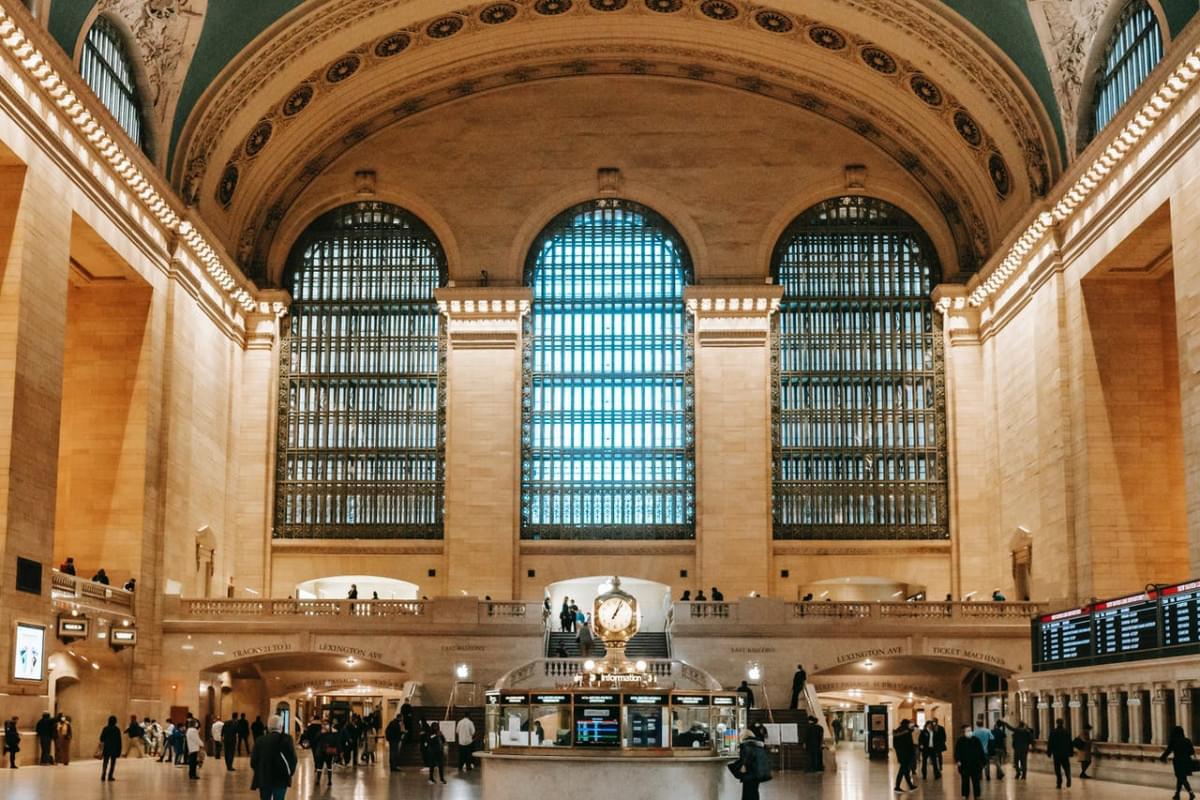 The best way to visit the Big Apple is to take advantage of its excellent public transport. You may be a little disoriented at first, as New York's underground system is one of the oldest in the world, but as soon as you understand how it works, you'll be able to get around without a problem. For public transport, run by the MTA company, it is recommended to buy the MetroCard, a rechargeable card costing $1.00 (€0.90) that will save you money. Valid on both metro and bus.
And besides public transport, there is no shortage of the unmistakable yellow taxis, with fairly cheap fares that you can stop right at the curb, just like in the movies. Alternatively, you can use Uber, downloading the app and checking in advance how much you are going to pay. Warning: remember that it is normal to tip, not only in restaurants, but also to taxi drivers! Tipping is usually 10% to 20% more than the fare paid. If a trip is short, it is normal to leave a $1.00 or $2.00 tip, or at least round up the amount requested. Usually, the tip tends to increase by a few dollars if the driver helps you load and unload luggage.
Metro
This is the best way to get around. It is one of the largest metros in the world and at first it may seem a little difficult to find your way around. Open 24 hours, it has 26 lines and 470 stations, covers a route of 1,055 km and connects all the districts of the city. The lines are of different colours and are marked by numbers or letters.
Downloadable map: click here
Timetable: 24 h
Ticketprice/single journey: $3.00 (€2.75), with MetroCard $2.75 (€2.50)
Ticket/subscription cost: 7-Day Unlimited-Ride MetroCard $33.00 (€30.30)
Bus
Using the buses is not complex, as the city has a very simple and linear structure of perpendicular streets, Avenues and Streets. So it will be very easy to find the right stop, also because the individual buses either move north/south back and forth, or east/west, with very linear routes and with stops on almost every block. There are about 14,000 stops, including all boroughs, and the different lines are distinguished by letters, numbers and colours (B Brooklyn, Bx Bronx, M Manhattan, Q Queens, S Staten Island, X Express Bus).
The Express Bus network has about 61 lines and they are buses that follow a route with only a few stops, only the most important ones, to ensure speedy travel. They mainly connect Staten Island and the Bronx with Manhattan and are mainly used by commuters and little by tourists.
Downloadable map: Manhattan Bus Map, Brooklyn Bus Map, Bronx Bus Map, Queens Bus Map
Hours: 24 hours
Ticketprice/single ride: $3.00 (€2.75), with MetroCard $2.75 (€2.50) / Express Bus $6.75 (€6.20)
Ticket price/subscription: 7-Day Unlimited-Ride MetroCard $33.00 (€30.30), 7-Day Unlimited Express Bus Plus $62.00 (€56.90)
By Car
Travelling by car in New York is really not recommended, especially because of the traffic! Getting around by underground is much quicker and you won't risk getting stuck in the city streets.
If you are not used to driving in big cities, it is better to avoid doing so in New York. The intersections are really big, the traffic lights are on every corner, the roads are wide with several lanes, and don't forget to watch out for cyclists, people on mopeds and pedestrians who don't always look when crossing! You can get around easily by public transport, or the many taxis or Uber, and it is still cheaper than renting a car.
Neighbourhood Slow Zones
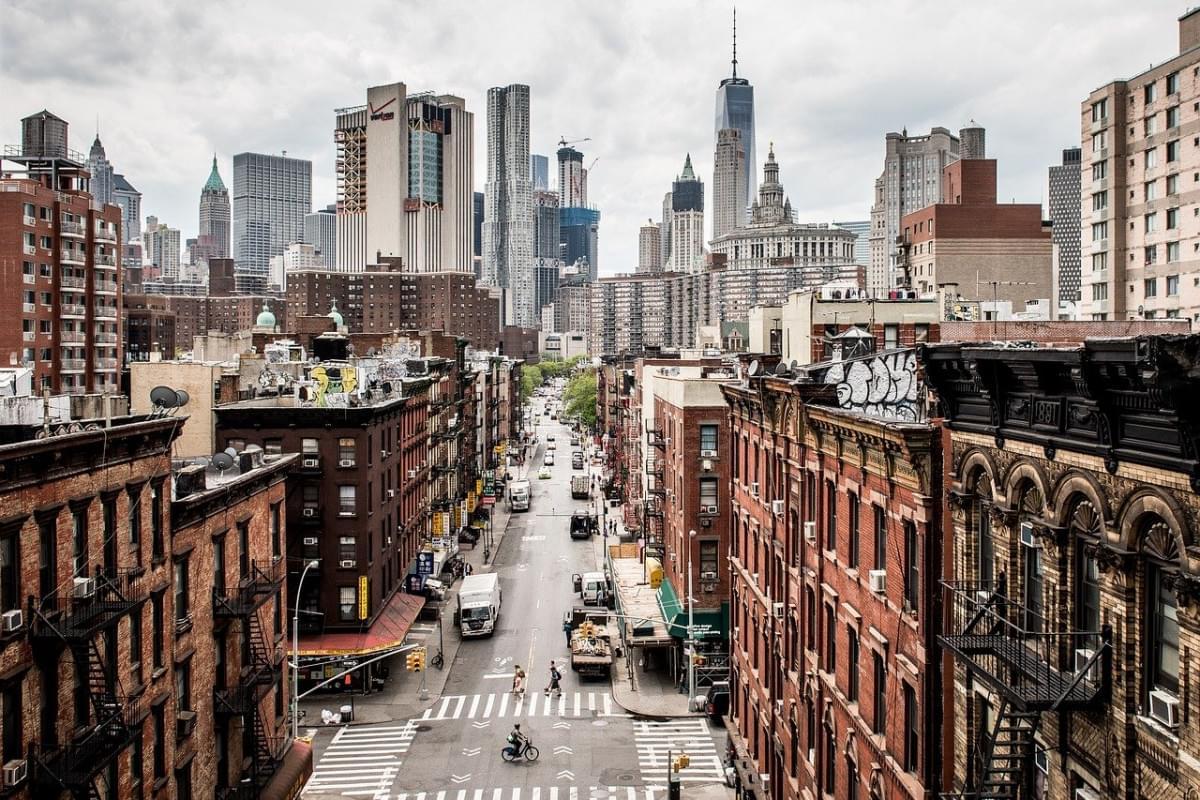 Watch out for Neighbourhood Slow Zones, i.e. areas where speed limits are stricter. Slow Zones are growing in number and have already reported a 14% reduction in accidents.
Neighbourhood Slow Zones can be found anywhere in the city, especially near residential neighbourhoods, and, most importantly, they are always marked by the Speed Limit road sign, which shows the speed limit to be observed, under penalty of heavy fines. You can find all the info and keep up to date on the official NYC DOT website of the New York government, where you can also find the complete list of zones.
Stops and parking
If you arrive in New York by car or decide to rent a car, the best solution is to check that the hotel where you are staying has parking facilities available! This is because parking in New York, especially in Manhattan, is very expensive! Here a parking space costs on average $20.00/hour (€18.35), but in central locations it can cost up to $50.00/hour (€45.90)! Many indoor and underground car parks offer cheaper daily and overnight packages, but still at high prices.
In addition to underground and guarded parking, you can also park above ground on the street, but it is not easy to find a space. Beware of parking rules and bans, which change street by street. Costs range from $1.00/h (€0.90) in the more suburban districts to $5.00/h (€4.60) in the more central ones. On Sundays, parking spaces are free in the suburbs.
Related articles
Where to sleep in New York: tips and best places to stay
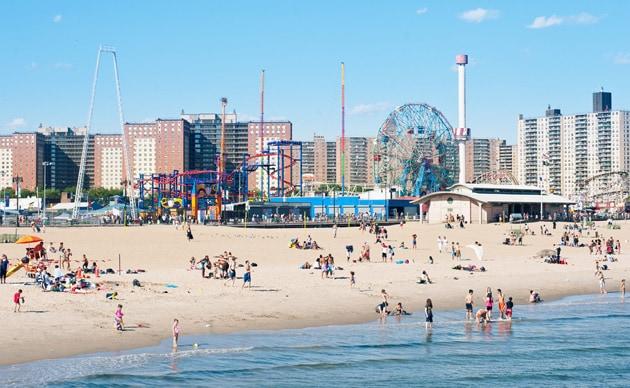
Where to go to the beach in New York | Beaches near New York
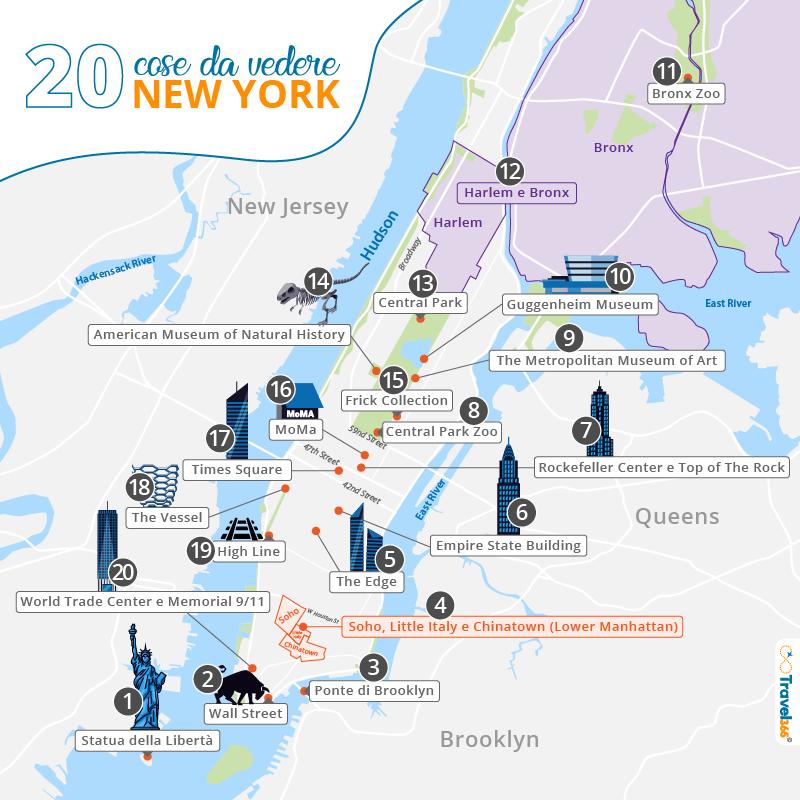
What to see in New York: 20 best attractions and things to do

New York itinerary in 7 days
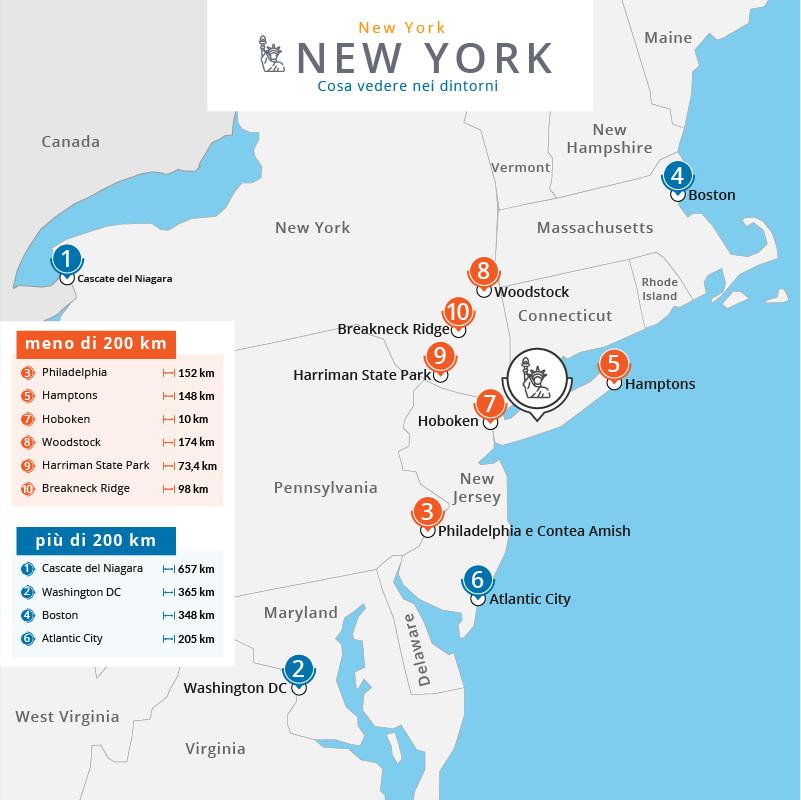
Excursions from New York: the best day trips around New York City
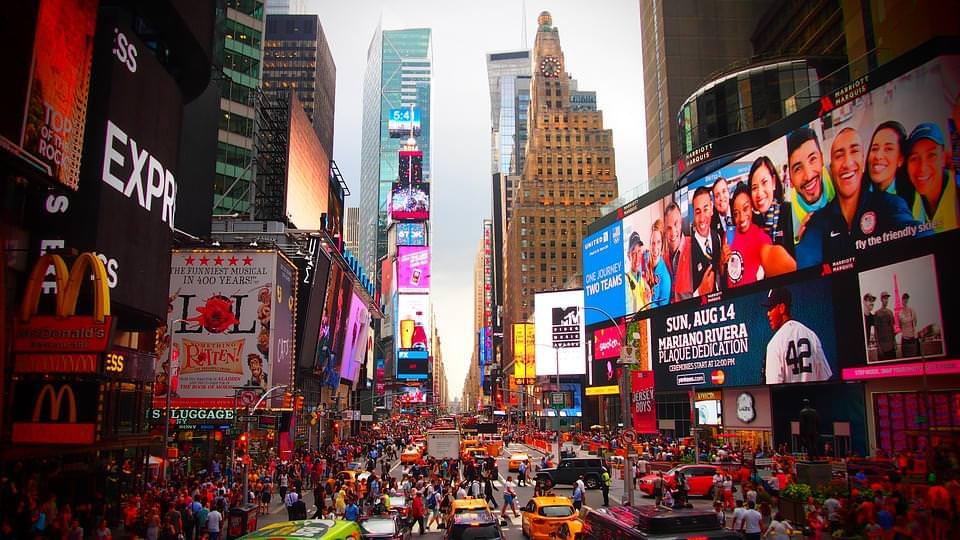
Christmas 2024 in New York: what to do, practical info and tips

Visiting New York for the first time: Tips and tricks
New Year's Eve 2024 in New York: What to Do, Offers and Tips